

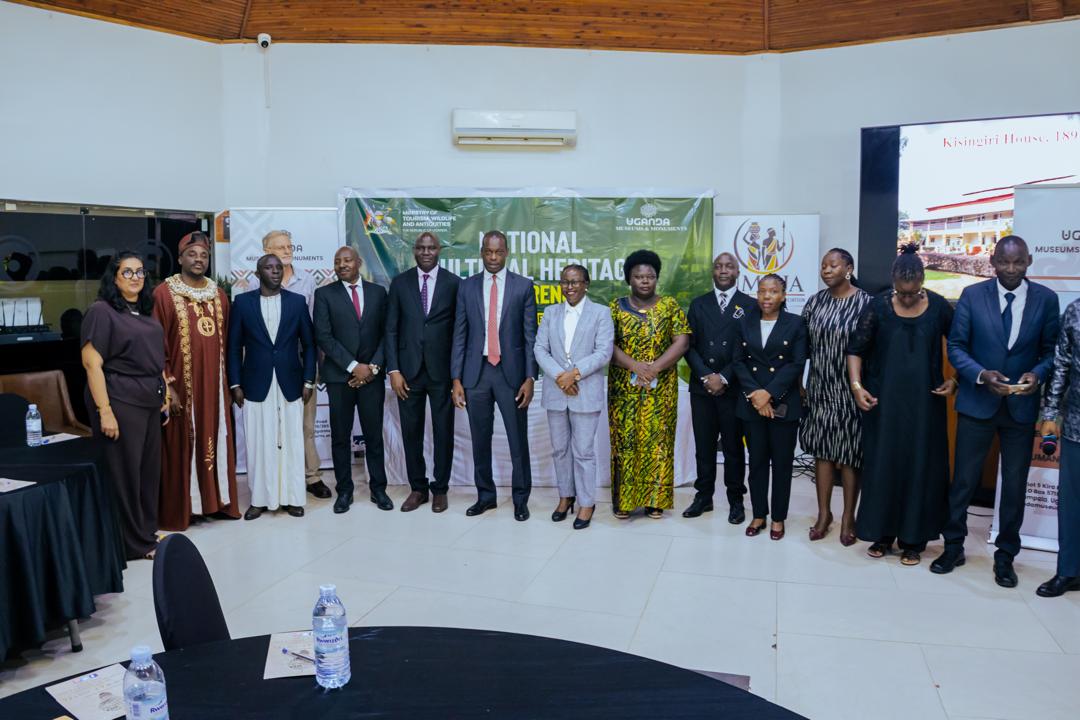
Uganda’s cultural, academic, and urban development leaders have urged stronger protection of the country’s architectural and cultural heritage amid rapid urbanisation.
These warned that unchecked modernization risks erasing identity, memory, and historical continuity embedded in cities.
The call came during the Third National Cultural Heritage Conference held at Fairway Hotel in Kampala under the theme “Urbanisation without Eraser: Architectural Heritage in Uganda’s Changing Urban Centres.”
The dialogue brought together policymakers, architects, scholars, cultural leaders, and urban planners to examine how Uganda can pursue development without sacrificing its heritage.
The conference highlighted growing concern that while cities across Uganda are expanding at a fast pace, historic buildings, traditional urban layouts, and cultural landscapes are increasingly under pressure from redevelopment and modernization.
Dr. Anthony Conrad K. Kakooza, an Intellectual Property and Cyber Law expert noted that cultural heritage is often taken for granted despite its depth and economic value, adding that Uganda’s cultural diversity—anchored in more than 56 ethnic communities—remains one of its most underutilized national assets.
“We have a culture that we belong to… Abundant natural resources take up the greatest part of the continent's economic wealth and, not least of all, a rich cultural heritage,” he said.
He referenced UNESCO’s definition of heritage as both tangible and intangible assets passed down through generations, stressing that Uganda’s traditions, languages, medicinal knowledge, and folklore represent significant innovation potential.
“Try and imagine the bounty of genetic resources, traditional medicinal knowledge, and cultural expressions that embody our cultural identity. It is on this premise that I say we seem to take this for granted.”
Dr. Kakooza pointed to indigenous knowledge systems that have already contributed to modern science, including herbal medicine derived from local plants.
“Our cultural heritage helped many during the COVID pandemic,” he said, citing locally developed remedies rooted in traditional knowledge.
However, he warned that weak regulatory systems and historical disruptions have led to the erosion of cultural practices and ownership structures.
“This legal gap is also rooted in years of cultural theft during the colonial era,” he said.
He further cautioned that Uganda is experiencing a “tragedy of the commons” where cultural heritage is used without clear protection or benefit-sharing systems.
“If no one has ownership or interest, it will be overused,” he said.
Dr. Lilian Namuganyi of Kyambogo University challenged Ugandans to view architecture as a cultural system rather than just physical infrastructure, warning that rapid urban growth is steadily erasing Uganda’s architectural memory.
“Heritage helps us examine our history and traditions. It enables us to understand why we are the way we are,” she said.
She noted that the drive for modern urban aesthetics is often coming at the cost of historical continuity.
“The push for a ‘modern city look’ risks erasing our architectural heritage,” she warned.
Dr. Namuganyi emphasized the importance of vernacular architecture, describing it as community-owned knowledge passed down through generations.
“Traditional architecture is community-owned knowledge, refined over generations,” she said.
She added that the separation between traditional and modern building systems has created cultural disconnection.
“There has often been a sudden rupture between traditional and modern systems, creating cultural disconnection,” she said.
The CEO of the Buganda Heritage and Tourism Board, Najib Nsubuga, underscored the role of architecture in expressing cultural identity and social organization.
“Historical structures like the Kasubi Tombs demonstrate architectural mastery in both concept and execution,” he said.
He explained that traditional architecture reflects hierarchy, function, and cultural meaning across communities.
“Different structures served different social roles—palaces for kings, residences for chiefs, and homes for commoners,” he said.
Nsubuga added that Uganda’s heritage is embedded not only in formal monuments but also in everyday cultural systems and built environments.
The State Minister for Tourism Martin Mugarra said Uganda’s rapid urban transformation must be managed carefully to ensure it does not erase cultural identity.
“Can development occur without erasing the very heritage that defines us?” he asked.
He described urban heritage as a “living system” made up of buildings, spatial arrangements, cultural practices, and collective memory.
“Every urban centre is, in essence, a living museum shaped by generations of human experience,” he said.
He warned that the destruction of historic buildings without adequate documentation risks permanent cultural loss.
“When heritage is erased, we lose not only our past but also opportunities for tourism, education, identity formation, and sustainable urban planning,” he said.
He urged alignment with international frameworks such as UNESCO’s Historic Urban Landscape approach and Sustainable Development Goal 11 on sustainable cities.
The Ministry of Tourism Permanent Secretary, Doreen S. Katusiime who was represented by Dr.Basil Ajer, the director for tourism in the ministry reaffirmed government commitment to integrating heritage protection into national development planning.
“Our built heritage is more than physical infrastructure. It is a repository of memory, identity, and meaning,” she said.
The permanent secretary acknowledged the pressures of rapid urbanisation but stressed that heritage must be embedded in planning systems rather than treated as an obstacle to development.
“We must confront a difficult reality: many of these heritage assets are under threat,” she said.
Mrs Katusiime linked the discussion to Uganda’s Vision 2040 and the National Development Plan IV, noting that urbanisation must support both economic transformation and cultural continuity.
“Urbanisation is not merely about expansion, but about creating productive, liveable, and sustainable cities supported by strong infrastructure, human capital, and cultural identity,” she said.
She also cited the Museums and Monuments Act as a key legal framework for protecting heritage sites such as the Uganda Museum, National Theatre, Namirembe Cathedral, Rubaga Cathedral, and the Namugongo Martyrs Shrines.
“Policy alone is not enough. We must engage communities and invest in conservation professionals who understand heritage-sensitive urban development.”
